 1:1 Mirror Quality


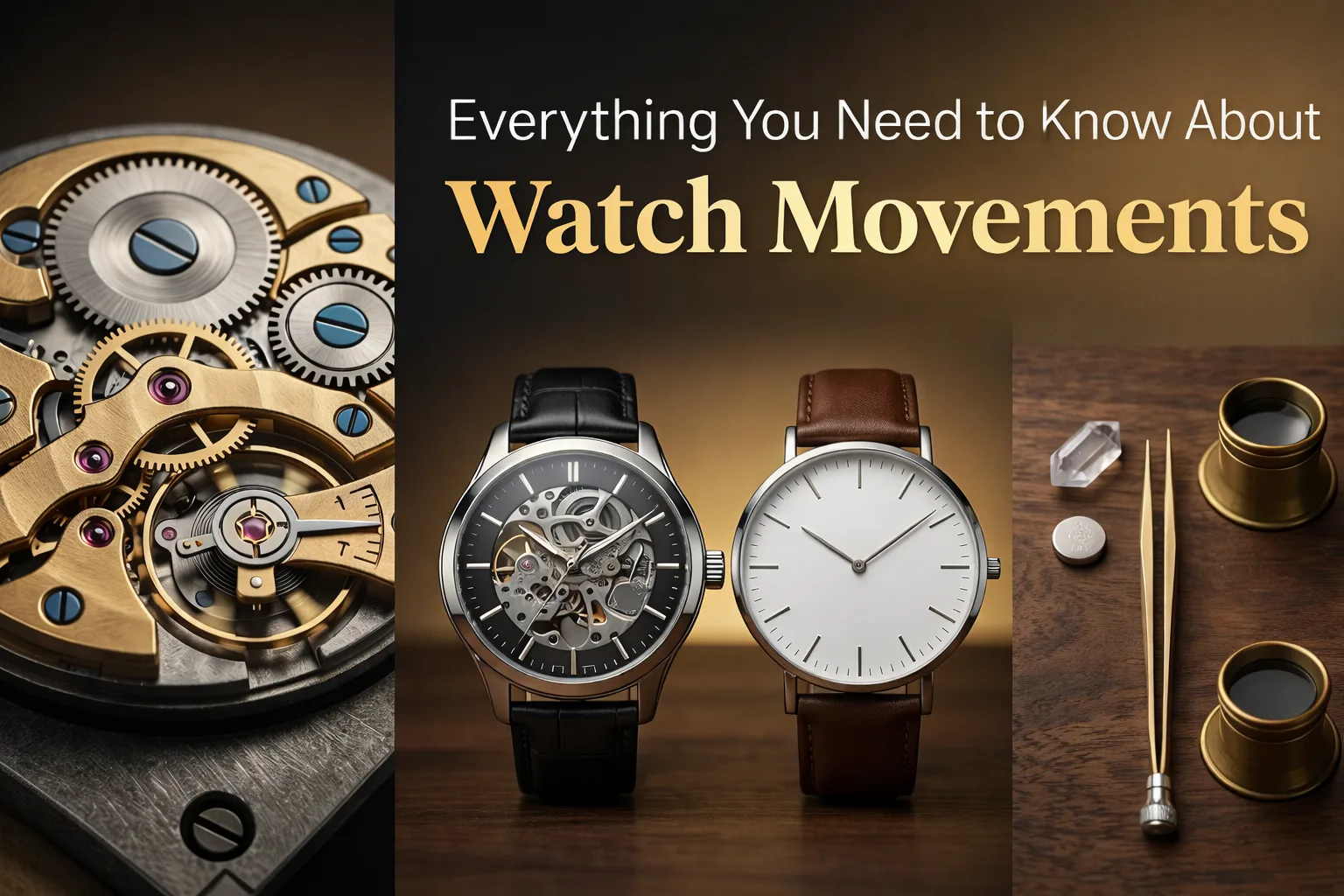
A Complete Guide for Every Kind of Watch Buyer
The Hidden Engine Behind Every Watch
Most people shopping for a watch start the same way: they look at the dial, check the brand name, and compare prices. That is completely natural. But if you have ever held two watches that looked nearly identical and wondered why one cost three times more than the other, the answer almost always lives inside the case.
The movement is the engine of your watch. It is what makes the hands move, what keeps time ticking, and what decides whether your watch runs for two days on a single wind or eight. It is also what separates a watch that feels premium from one that simply looks it.
Understanding movements does not require an engineering degree. In fact, once you know the basics, choosing a watch becomes a lot less confusing and a lot more satisfying. This guide breaks it all down in plain language, so whether you are buying your first watch or your fifth, you will know exactly what you are getting.
What Is a Watch Movement?
Think of a watch movement as the engine inside your car. You do not see it when you are driving, but everything depends on it. Without the engine, the car is just a nice-looking piece of metal sitting in your driveway. Without the movement, a watch is just a bracelet with a dial.
In technical terms, the movement is the internal mechanism responsible for measuring the passage of time and moving the watch's hands accordingly. Every tick you hear, every smooth sweep of a second hand, and every accurate display of hours and minutes, all of that comes from the movement doing its job.
Why does movement matter when you are choosing a watch? Three reasons:
- Accuracy
A good movement keeps precise time. A poor one can drift by several minutes a day, which is more frustrating than you might think.
- Longevity
The movement determines how long the watch will last and how often it needs maintenance or a battery change.
- User experience
Some movements feel mechanical and satisfying to wear. Others are quiet, effortless, and nearly maintenance-free. Your lifestyle should guide which one suits you.
Movements generally fall into three categories: quartz, automatic, and manual mechanical. Each has a different way of generating and storing power, and each comes with its own set of trade-offs.
The Main Types of Watch Movements
Read this 3 main types of watch movements.
Quartz Movement
Quartz is the most common type of movement in the world, and for good reason. It is reliable, affordable, and impressively accurate. If you change a battery in your watch every year or two, you almost certainly have a quartz movement.
Here is how it works in simple terms: a small battery sends an electric current through a tiny piece of quartz crystal. That crystal vibrates at a very precise rate: 32,768 times per second. Those vibrations are counted by a circuit, which then drives the hands at a consistent, predictable speed.
The result is a watch that can stay accurate to within five seconds per month. Compare that to a mechanical watch, which is considered excellent if it stays within a few seconds per day. Quartz simply wins on pure accuracy.
Beyond accuracy, the practical advantages are hard to argue with:
- No winding required; the battery does everything
- Easy to maintain: just replace the battery every one to two years
- Works consistently whether you wear it every day or leave it in a drawer for weeks
- Available at nearly every price point
Automatic Movement
An automatic movement is a type of mechanical movement, but with a clever twist. Instead of requiring you to wind it by hand, it winds itself using the natural motion of your wrist throughout the day.
Inside an automatic watch, there is a small weighted piece called a rotor. As your arm moves, the rotor swings around and gradually tightens a coiled metal spring called the mainspring. That stored energy is then slowly released through a series of gears, which drives the hands forward. It is an elegant self-contained system with no battery required.
One thing to know: if you leave an automatic watch sitting still for too long, say, a few days in a safe or on a nightstand, it will wind down and stop. You would then need to wind it manually through the crown or give it a few shakes to get it going again. For daily wearers, though, this is rarely an issue.
What makes automatic watches attractive to enthusiasts:
- No batteries ever: the watch is powered purely by motion
- A smooth, sweeping second hand that feels distinctly premium
- A sense of connection to traditional watchmaking craftsmanship
- Satisfying to wear: you are literally powering the watch with your wrist
Automatic-inspired designs in the first copy segment are crafted to closely mirror the look, feel, and movement style of genuine automatic watches, giving you that premium wearing experience without the premium price tag.
Mechanical Movement
The hand-wound mechanical movement is the oldest type of watch movement in existence, dating back centuries. Before automatic mechanisms were developed, every watch had to be wound by hand, typically using a small key and later the winding crown on the side of the case.
The principle is the same as an automatic watch: a coiled mainspring stores energy and slowly releases it through a gear system to drive the hands. The difference is that there is no rotor to wind it automatically. You have to do it yourself, usually every one to three days, depending on the watch.
Today, hand-wound movements are relatively rare outside of high-end watchmaking, where they are prized for their traditional craftsmanship and the daily ritual of winding. They tend to be slimmer than automatic movements because there is no rotor taking up space.
Who are manual mechanical watches for?
- Watch collectors and enthusiasts who appreciate tradition
- People who enjoy the daily ritual of winding their watch
- Those drawn to skeleton or open-heart designs that display the movement
Quartz vs. Automatic: Which One Should You Choose?
This is the question most buyers end up asking, and the honest answer is 'It depends on what you value.' Neither is universally better. They are just different.
Here is a straightforward comparison:
Accuracy
Quartz wins here, and it is not particularly close. A good quartz movement stays accurate to within five seconds per month. A well-made automatic movement might drift by a few seconds per day. For most daily use, the difference is barely noticeable, but if you need to check the exact time at a glance and trust it completely, quartz gives you more confidence.
Feel and Presence
Automatic watches have a certain quality that is hard to put into words but easy to notice on the wrist. The sweeping second hand, the slight weight from the rotor, and the knowledge that the watch is running on nothing but the motion it creates a different kind of connection to the watch. For many buyers, that tactile experience is worth a great deal.
Maintenance
Quartz is nearly effortless. Change the battery every year or two, and you are done. Automatic movements, on the other hand, may need a professional service every few years to keep all the tiny gears and oils in good shape. This is not a deal-breaker, but it is worth knowing.
Price
Quartz movements are significantly less expensive to manufacture, which is why they dominate the affordable end of the market. A well-made quartz watch at a reasonable price will outperform a poorly made automatic at the same price point every time.
If you want accuracy, low maintenance, and everyday reliability, go quartz. If you want a premium feel, a satisfying wearing experience, and a connection to watchmaking tradition, go automatic.
How Movement Affects First Copy Watches
First copy watches occupy an interesting space in the market. They are designed to deliver the visual experience of premium timepieces at a price that most buyers can actually afford. And when it comes to movements, the choices made inside the case have a real impact on how the watch performs day to day.
Quartz in First Copy Watches
The majority of first-copy watches use quartz movements, and this is genuinely the right call for most buyers. Quartz offers consistent performance, accurate timekeeping, and minimal upkeep, all without adding to the cost of the watch itself.
When you pick up a first-copy watch with a quartz movement, you are getting the following:
- Reliable timekeeping that matches or exceeds what you would get from a mid-range brand-name watch
- A movement that works just as well in summer heat as it does in winter cold
- No concerns about the watch stopping if you leave it in a drawer over the weekend
- A battery that typically lasts one to two years before needing a replacement
For everyday wear – commuting, meetings, casual outings, and travel – a quartz-powered first-copy watch simply works. It does exactly what a watch is supposed to do, without asking anything complicated of you.
Automatic-Inspired Designs
Some first-copy watches take inspiration from the look and feel of automatic timepieces. These designs are crafted to closely mirror the aesthetic of genuine automatic watches: the sweeping motion, the visible rotor in skeleton-style dials, and the weighted feel on the wrist.
This approach gives buyers something genuinely appealing: a watch that feels premium without the steep price of an original automatic. If you have always admired the experience of wearing an automatic but were not ready to spend heavily on one, these designs offer a real entry point.
Our watches are crafted to closely reflect the design and working style of original automatic and mechanical watches, giving you a similar visual and wearing experience at a fraction of the cost.
Mechanical-Style Aesthetics
Some first copy designs lean into the visual appeal of mechanical watchmaking without necessarily replicating the internal mechanics. Skeleton dials, open-heart designs, and exhibition casebacks all showcase intricate-looking components that are genuinely beautiful to look at.
These watches appeal to buyers who are drawn to the artisan look of fine watchmaking. The focus here is less on mechanics and more on visual craftsmanship, and in that respect, many of these designs do a remarkable job.
How to Choose the Right Movement for You
With all of the above in mind, here is a simple way to match yourself to the right movement based on how you actually live and wear your watch.
Choose Quartz If...
- You wear different watches on different days and want one that keeps ticking no matter how long it sits
- You travel frequently and need a watch you can count on in different time zones and climates
- You prefer low-maintenance ownership: set it, wear it, forget it
- Precise timekeeping matters to you daily
- You are looking for the best value at a given price point
Choose Automatic Style If...
- You are a daily wearer who will have the watch on your wrist most of the time
- You are drawn to the sweeping second hand and the premium feel it creates
- You appreciate the idea of a watch powered by your own movement
- You enjoy the ritual and personality that comes with mechanical-style watches
Choose Mechanical-Inspired Aesthetics If...
- You are a collector or enthusiast who loves the visual drama of exposed movement components
- You want a skeleton or open-heart design that doubles as a conversation piece
- Style and visual craftsmanship are your primary criteria
The most important thing is to match your watch to your lifestyle, not just your taste. A beautiful automatic that stops every time you take it off is frustrating. A reliable quartz that you trust completely is always satisfying.
The Right Watch Is the One That Works for You
Understanding watch movements changes the way you shop. Instead of being guided purely by how a watch looks on the outside, you start to think about what it does on the inside and whether that matches what you actually need.
Quartz movements give you accuracy and ease. Automatic-style designs give you a premium experience and that satisfying sweep of the second hand. Mechanical-inspired aesthetics give you something visually striking that stands apart from the crowd. None of these is wrong. They are just different answers to the same question: what do you want your watch to do for you?
The best watch is not necessarily the most expensive one or the one with the most complicated movement. It is the one that fits your life, performs reliably, and makes you want to put it on every day.
Now that you know the difference, you can make that choice with confidence.
A Final Word on Choosing the Right Watch
At the end of the day, what matters most is how a watch fits into your lifestyle. Whether you prefer the accuracy of quartz or the feel of automatic-style designs, the goal is simple: reliability, comfort, and a design you enjoy wearing every day.
We offer luxury-inspired watches that are designed to closely match the look, feel, and functionality of original timepieces. From quartz-powered reliability to automatic-style experiences, our collection is built to give you the same everyday performance without the premium price tag.
What makes us different is consistency. Every watch is selected with attention to detail, from design accuracy to functional quality, so you are not just buying something that looks good but something that works well too.
We’ve built a strong reputation as one of the largest sellers of first-copy watches, trusted by customers who want premium designs without overspending. Our collection includes styles inspired by globally recognised names like Rolex, Rado, Omega, Hublot, Breitling, and Emporio Armani, all crafted to reflect similar design language and user experience.
If you want to explore the full range, you can browse our complete collection here:
https://firstcopywatches.online/
Frequently Asked Questions for Movements of Watches.
1. Does the movement really matter when buying a watch?
Yes, more than most people think. The movement affects how accurate your watch is, how often it needs maintenance, and how it feels to wear daily.
2. Which watch movement is best for everyday use?
For most people, quartz is the easiest option. It’s accurate, low-maintenance, and works even if you don’t wear the watch regularly.
3. Why do automatic watches feel more premium?
It’s mainly because of how they work. The smooth sweeping second hand and the fact that they run on wrist movement give them a more “alive” feel compared to quartz watches.
4. Do automatic watches stop if you don’t wear them?
Yes, they can. If left unused for a couple of days, they may stop and need to be wound again.
5. Are quartz watches less valuable than automatic ones?
Not really. Quartz watches are actually more accurate and practical. Automatic watches are valued more for craftsmanship and experience, not performance.
6. How often does a quartz watch need a battery change?
Usually every 1–2 years, depending on usage and battery quality.
7. Are first copy watches reliable in terms of movement?
Many are, especially quartz ones. They’re designed for consistent everyday use and generally perform well if chosen carefully.
8. What is better for beginners: quartz or automatic?
Quartz is better for beginners because it’s simple, reliable, and doesn’t require much attention.
9. Is a mechanical watch practical for daily use?
It can be, but only if you’re okay with winding it regularly. Otherwise, it may feel inconvenient compared to quartz.