 1:1 Mirror Quality


The First Thing People Notice
Before you say a word, people are already reading you. The way you walk into a room, the way you carry yourself, the details you wear; they all tell a story. And your watch? It tells more than you think.
A watch is not just a tool to check the time. It is a quiet signal of who you are. When it looks polished and well-kept, it adds to your presence. When it looks dull, scratched, or worn out, it quietly takes something away, even if no one says it out loud.
The good news is that maintenance has nothing to do with how expensive your watch is. It is about how much attention you give to what you wear. Whether you own a luxury timepiece or a first-copy watch, the same principle applies: care reflects character. And character shows up in the details.
This guide is here to help you build that habit, not with complicated instructions, but with simple awareness that protects your watch for years.
The Silent Damage You Don't Notice
Most damage to the watch does not happen all at once. There is no dramatic scratch or sudden breakdown. It sneaks in quietly, day after day, until one morning you look at your wrist and wonder, when did it start looking like this?
Here is what is happening while you are not paying attention:
Sweat buildup under the strap:
Every time you wear your watch, skin contact leaves behind moisture, salt, and oils. Over time, this breaks down both the strap material and the area around the case back.
Dust settling into edges and joints:
Tiny particles collect in the crown, between bracelet links, and around the bezel. This is not just cosmetic; it can affect how parts move over time.
Micro-scratches from daily use:
Your desk, your laptop's edge, your car door – every surface you brush against leaves a faint
Mark. Alone, each one is invisible. Together, they dull the finish.
Moisture in the air:
If you live in a humid climate, your watch is exposed to invisible water particles constantly. Over time, this reaches inside and affects the movement of the dial.
Friction from everyday surfaces:
Even resting your wrist on a keyboard all day creates small, repeated contact that gradually wears the case and crystal.
None of this feels urgent in the moment. But the damage builds. And by the time it looks serious on the outside, it has often been working on the inside for a long time. The earlier you pay attention, the less there is to fix.
The “2 Minute Routine” That Keeps Your Watch Looking New
You do not need an hour on a weekend or a professional service every month. What you need is consistency, a few small habits repeated often enough to prevent buildup before it starts.
Here is a simple routine broken into daily, weekly, and monthly steps:
Daily
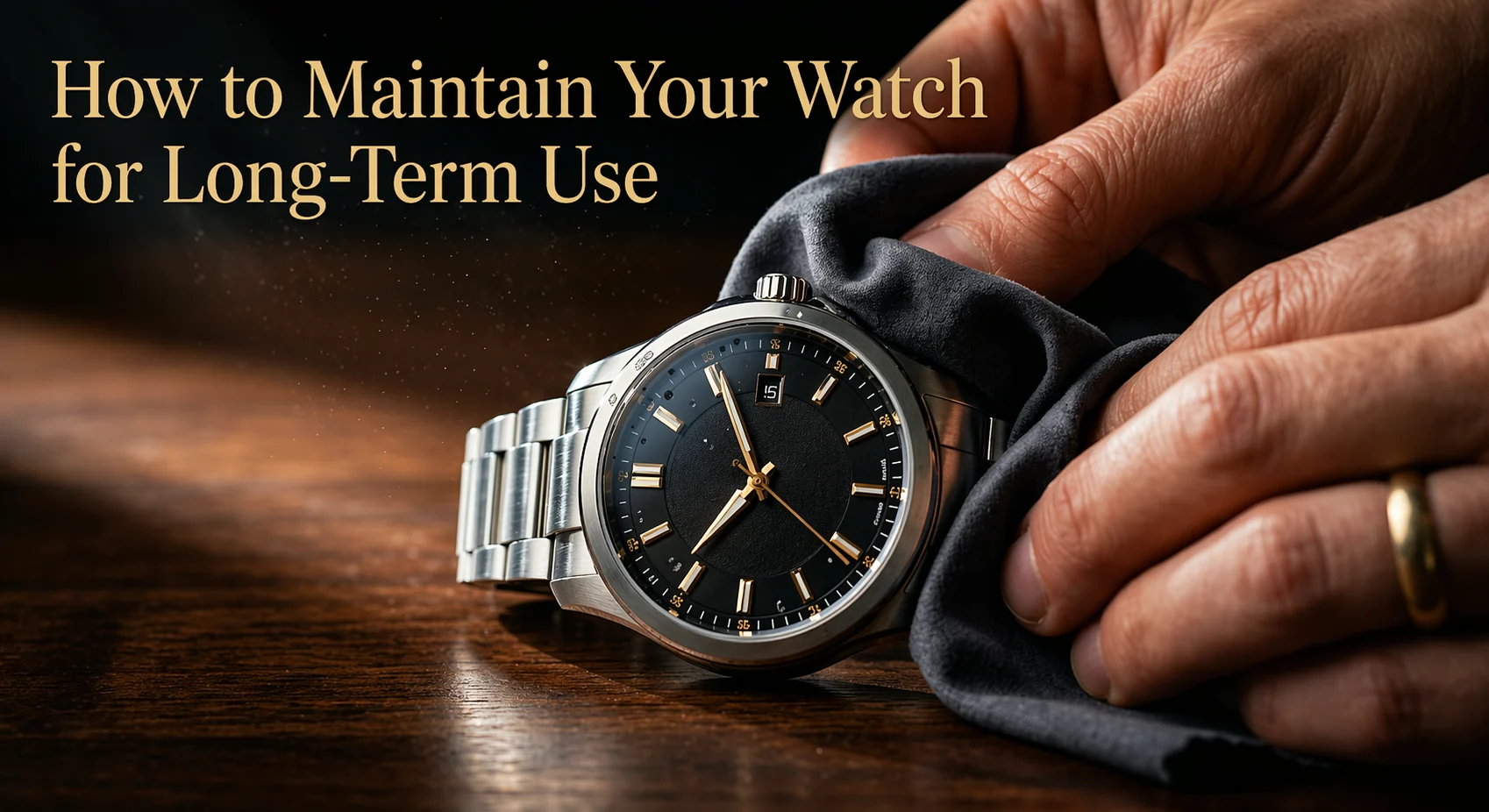
- Wipe your watch with a soft, dry cloth after you take it off. This removes sweat, dust, and surface oils before they settle in.
- Place your watch on a soft surface, a cloth pouch, a watch roll, or even a folded handkerchief. Avoid hard or rough surfaces that can cause accidental scratches.
Weekly
- Clean the strap thoroughly, especially the inner side. The back of the strap absorbs the most sweat and dirt throughout the week. A slightly damp cloth works well for most strap types.
- Wipe the case and dial edges where dust tends to collect around the lugs and crown.
Monthly
- Check for any visible dust buildup in the joints of a metal bracelet or around the pushers.
- Look at the dial under good light. Early signs of moisture appear as slight cloudiness or a subtle loss of colour depth. Catching this early can prevent a much bigger problem later.
This entire routine takes two minutes on most days. The value is not in how long it takes; it is in doing it regularly. Consistency is what keeps a watch looking new long after the purchase.

The Small Things That Make The Biggest Difference is that
Every watch owner faces the same small problems over time. The difference between a watch that lasts years and one that ages badly usually comes down to whether these things are addressed early or ignored until they are too far gone.
Here is what to look out for and what to do:
Scratches from everyday contact with surfaces: This is the most common form of damage. Fix: Avoid placing the watch face down on any surface, and be mindful around edges and rough materials. A screen protector film is an option for high-use watches.
- Loss of shine from sweat and dust buildup: Sweat is slightly acidic and dull finishes faster than most people expect. Fix: Wipe daily and clean the edges weekly to prevent buildup from forming.
- Leather straps wearing out prematurely: Leather absorbs sweat, stiffens, and cracks when repeatedly exposed to moisture without time to dry. Fix: Keep leather away from water, air dry it completely after wearing, and avoid putting the same leather strap on two days in a row if you sweat heavily.
- Metal straps losing their polish: Between the links is where dirt hides and where the finish fades first. Fix: Clean occasionally with a soft brush and warm water, then dry properly. Do not leave moisture between the links.
- Rubber straps collecting dirt and odour: Rubber traps sweat and debris in its texture. Fix: Rinse with clean water and dry completely. Do not leave a wet rubber strap on your wrist.
- Colour and finish fading from chemicals and sunlight: Cologne, sunscreen, and prolonged UV exposure are quite the enemies of watch finishes. Fix: Always apply perfume or cologne before putting on your watch, not after. Avoid leaving the watch in direct sunlight for extended periods.
- Sweat damage in hot climates: In warmer regions, sweat exposure is constant and more concentrated. Fix: Wipe the watch down immediately after outdoor use and allow it to air out before storing.
- Water exposure weakens the watch gradually: More on this in the next section, but the key point here is that the seals protecting your watch degrade over time. Fix: Avoid unnecessary water contact and do not test the limits of water resistance in everyday situations.
Long-term damage is rarely caused by one dramatic incident. It is the result of repeated small neglect: the same scratches, the same sweat, the same moisture, over and over again. Break that cycle early, and your watch stays in much better shape.
The Truth About Water: “Resistant” Doesn’t Mean Safe
Here is a misconception that causes a surprising amount of watch damage: water resistance does not mean waterproof.
Most watches are rated for a level of water resistance of 30 metres, 50 metres, or 100 metres. What many people do not realise is that these ratings describe static pressure in controlled test conditions. Real-life water exposure is different. The pressure from washing your hands quickly, the sudden splash from rain, and the warm water from a shower, all of these apply pressure differently than the rating anticipates.
More importantly, water resistance degrades over time. The gaskets and seals inside your watch that create the barrier against moisture are made from rubber and silicone. They compress, dry out, and lose their effectiveness over years of use, especially with regular temperature changes.
What this means practically:
- A watch that was rated water resistant when new may not hold the same rating five years later without a service.
- Warm water from showers or washing up is harder on seals than cold water because heat accelerates gasket degradation.
- Soap and chemicals in the water can further break down both the seals and the strap material.
Water is not an immediate threat. It is a slow, gradual one. Treat your watch’s water resistance as a safety net for accidental exposure, not a feature to rely on daily. The less unnecessary water contact your watch has, the longer it will stay protected.
Your Strap Is Ageing Faster Than The Watch Itself.
If you pay attention to one part of your watch more than any other, make it the strap. The case and dial are relatively protected. The strap takes the full force of everything: sweat, friction, heat, moisture, and daily bending every time you move your wrist.
Every strap type ages differently, and each one needs a slightly different approach.
Leather Straps
Leather looks excellent and feels comfortable, but it is the most vulnerable to neglect. Sweat is absorbed directly into the material. If the strap does not have time to dry completely between wears, the leather becomes stiff, then begins to crack along the fold points. Once cracking starts, it cannot be reversed.
- Let the strap dry fully after wearing before storing.
- Keep it away from prolonged water exposure.
- Rotate between straps if you wear a watch daily.
Metal Straps
Metal bracelets look durable, and they are but the area between the links is where problems hide. Dirt, dead skin, and moisture collect there and are difficult to see. Over time this causes the finish to dull and, in some cases, the pins holding links together to weaken.
- Clean between the links periodically with a soft brush.
- Dry thoroughly after any water exposure.
- Look for loose links or pins as an early maintenance signal.
Rubber Straps
Rubber is the most practical choice for active wear, but it holds onto moisture and odour. The texture that makes it comfortable against skin is also what traps sweat in.
- Rinse with fresh water after sweaty or outdoor use.
- Dry completely; do not store while still damp.
- Avoid contact with oils and solvents, which can cause rubber to degrade.
Regardless of strap type, replacing a worn strap is one of the easiest and most affordable ways to refresh the entire look of a watch. If you are looking for options, browsing first copy watches can give you a good sense of what works well with different case styles.
What Your Watch Type Needs From You
Not all watches are built the same, and the maintenance each one needs is different. Before getting into the specifics, it helps to understand what sets these three types apart because the confusion is common.
What Is A Quartz Watch?
A quartz watch runs on a battery. The battery sends an electrical current through a small piece of quartz crystal, which vibrates at a precise frequency. Those vibrations power the movement and keep the time. Quartz watches are known for being accurate, affordable to maintain, and low-maintenance to own. The second hand typically ticks in individual, distinct steps.
What a quartz watch needs from you:
- Replace the battery on time, typically every one to three years depending on the model.
- Do not leave a dead battery inside the watch. Old batteries can leak and permanently damage the movement.
- Beyond battery changes, quartz watches are low maintenance. But the timing of the battery replacement matters more than most owners realise.
What Is An Automatic Watch?
An automatic watch has no battery. It powers itself through the natural movement of your wrist. Inside the watch is a rotor, a weighted component that spins as you move, which winds the mainspring and stores energy to keep the watch running. The second hand typically has a smooth, sweeping motion.
What an automatic watch needs from you:
- Regular wear. If an automatic sits unworn for several days, it will stop. Wearing it daily keeps the energy topped up.
- If you are not wearing it consistently, a watch winder can keep it running without wearing it.
- Avoid dropping or subjecting it to heavy shocks. The movement is mechanical and sensitive to impact.
What Is A Mechanical Watch?
A mechanical watch also runs without a battery and is fully hand-powered. Unlike an automatic, it does not wind itself through wrist movement; you must wind it manually using the crown. It is the oldest form of watchmaking and often represents the highest level of craft in horology.
What a mechanical watch needs from you:
- Wind it daily, preferably at the same time each day to build the habit.
- Do not overwind. Once you feel resistance, stop. Overwinding can damage the mainspring.
- Handle with care. Like automatics, mechanical movements are sensitive to shocks and drops.
Understanding which type of watch you own changes how you approach its care. The right maintenance for one type can be wrong or even harmful for another.
When Your Watch Is Asking For Help
Watches do not break suddenly out of nowhere. Long before a significant problem appears, they give you smaller signals and signs that something needs attention. Most people miss them because they do not seem serious at first. But ignoring them long enough turns small issues into expensive repairs.
Here are the early warning signs to watch for:
- Losing time gradually: If your watch is consistently running a few seconds or minutes slow or fast each day, the movement is trying to tell you something. This can signal a dying battery in a quartz watch or that an automatic or mechanical watch needs servicing.
- Fog or condensation under the glass: This is moisture inside the case. It means a seal has failed and moisture has entered. This needs professional attention quickly; moisture in the movement causes corrosion.
- Stiff or visibly deteriorating strap: If the strap cracks, becomes brittle, or starts to smell despite cleaning, it is past the point of maintenance. Replace it before it snaps and the watch falls.
- Crown that does not turn or set smoothly: The crown should operate with consistent, gentle resistance. If it feels stiff, gritty, or loose, do not force it. This usually indicates wear or debris in the threads.
- Visible dullness or surface haze on the dial: Not all dullness is external. A slight haze on the inside of the crystal can indicate trapped moisture or degraded finish. Catching it early often means a simpler fix.
Each of these signals is an early message. A watch that receives timely attention at this stage almost always recovers fully. A watch that is ignored tends to develop problems that cost significantly more to address.
If You Want It To Last Years, Treat It Like This
There are no secrets to long-term watch care. The people who wear their watches for decades without losing quality are not doing anything extraordinary. They are doing the ordinary things consistently.
A few principles that carry the most weight over time:
- Consistency over intensity: A two-minute wipe-down after every wear does more for your watch than an occasional deep clean. Daily habits compound into real protection.
- Awareness of environment: Know where your watch is at risk at the gym, in the kitchen, or on a construction site. That awareness alone changes small behaviours without requiring effort.
- Respect what it is made of: Leather, rubber, and metal each have limits. Understanding those limits means you avoid placing your watch in situations where it has no protection.
- Respond early to changes: The earlier you notice something different, a new scratch, a slight fog, or a strap that feels different, the easier it is to address. Most watch problems are solved cheaply when caught early and expensively when left alone.
- Store it with intention: When you are not wearing it, give your watch a proper place to rest. A soft surface, away from direct sunlight and humidity, is all it needs.
None of this requires technical knowledge. It requires the kind of attention you already give to other things you value. Your watch responds to the same care.
Our First Copy Watches: Built To Last, Designed To Be Worn
Maintenance only makes sense when the watch is worth maintaining. A well-crafted watch, one built with quality materials, precise finishing, and genuine attention to detail, responds to care and rewards consistency over time. One that is poorly made will struggle regardless of how carefully you treat it.
This is exactly what makes the choice of watch important from the start.
Luxury watchmaking has long been defined by a handful of names. Rolex, known for the Submariner and Day-Date, builds watches around precision engineering and surface finishing that holds up for decades. Patek Philippe creates timepieces that are handed down across generations. Audemars Piguet, with the Royal Oak, turned industrial aesthetics into fine watchmaking. Omega, worn by astronauts and divers, is known for durability under real-world conditions. Tag Heuer has built its reputation on sport and precision timing. These brands represent what it means to build a watch with intention.
Our first copy watches are crafted with the same respect for detail. The finishing, the weight, the movement of the hands, and the texture of the dial, each element is considered. These are not watches built to be discarded. They are built for daily wear, and they hold up when treated well.
A first copy Rolex Submariner follows the same maintenance principles as the original: regular wiping, mindful storage, strap care, and prompt attention to early warning signs. The routine does not change because the watch is accessible. The outcome does not change either.
Whether you are drawn to the clean lines of an Omega Seamaster silhouette or the bold presence of an Audemars Piguet Royal Oak-inspired design, the watches in our collection are made to be worn confidently and maintained the same way a serious watch owner would maintain any quality piece.
A watch does not need to be expensive to look powerful. It just needs to be worn and maintained the right way.
Questions People Usually Realize Too Late
1. How often should I actually clean my watch?
You don’t need a deep clean every day. A quick wipe after wearing it is enough daily. Proper cleaning once a week keeps buildup from turning into damage.
2. Can sweat really damage my watch that much?
Yes, more than most people think. Sweat contains salt and moisture that slowly affect straps, finish, and even the case over time, especially in hot climates.
3. Is it okay to wear my watch while washing my hands or in the rain?
Occasional exposure is usually fine, but it shouldn’t become a habit. Water resistance is not permanent, and repeated exposure weakens protection over time.
4. Why does my watch lose its shine even if I don’t use it roughly?
Because shine fades from buildup, not just damage. Dust, sweat, and oils collect slowly and dull the surface if not cleaned regularly.
5. Which part of the watch wears out the fastest?
The strap. It faces constant sweat, friction, and movement. In most cases, the strap ages much faster than the dial or case.
6. How do I know if my watch needs attention or repair?
Look for small signs: slight time loss, fog under the glass, stiff strap, or rough crown movement. Watches usually show early warnings before bigger issues.
7. What happens if I don’t change the battery on time in a quartz watch?
Leaving a dead battery inside can damage the internal movement due to leakage. It’s a small delay that can turn into a bigger repair.
8. Do automatic watches stop if I don’t wear them daily?
Yes. They depend on wrist movement. If not worn regularly, they stop—but they start again once worn or wound.
9. Are first copy watches worth maintaining properly?
Absolutely. A well-made first-copy watch responds to care just like any other watch. With proper maintenance, it keeps its look, performance, and presence over time.