 1:1 Mirror Quality

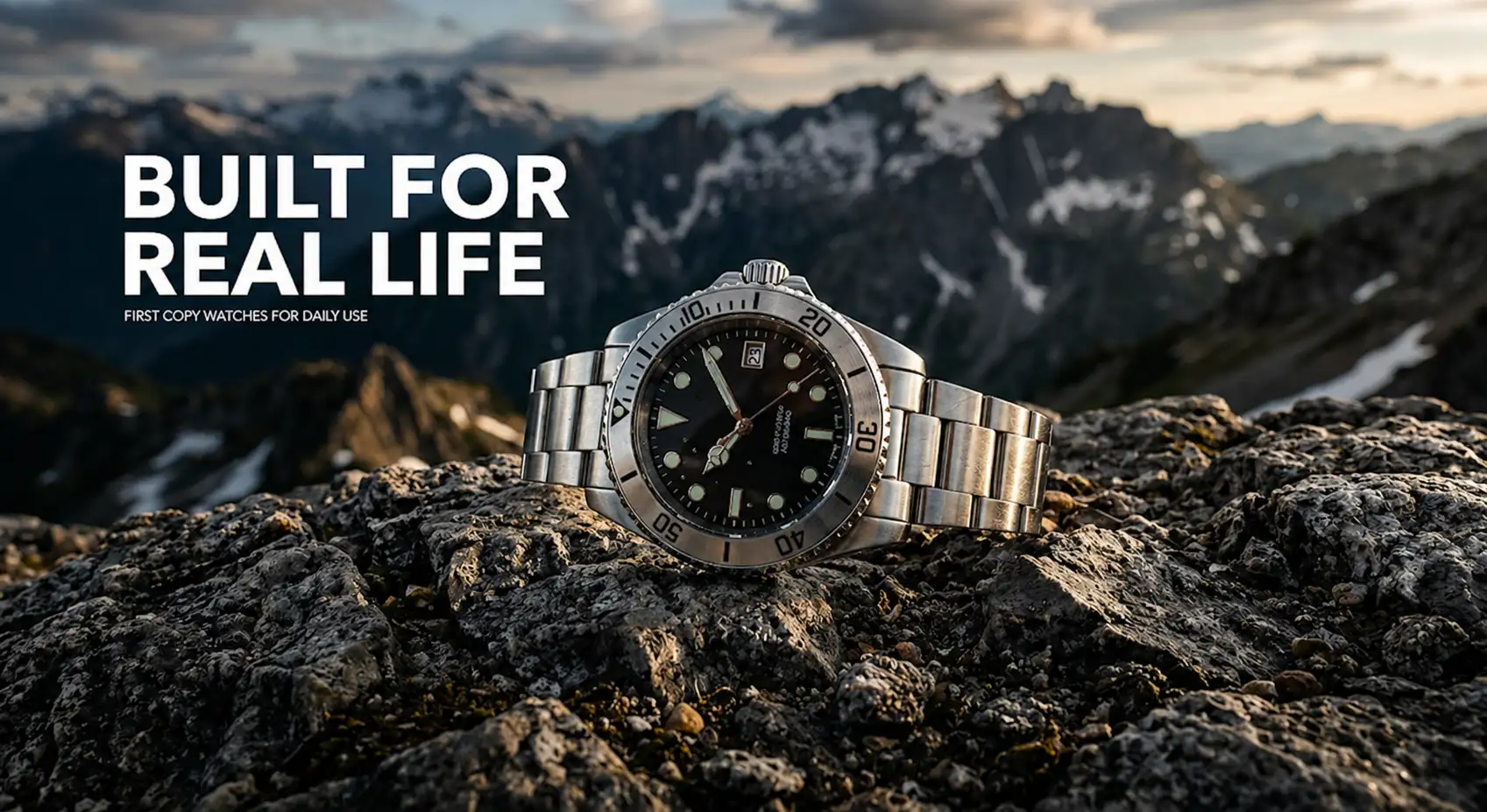
Let's be honest about what a single day actually looks like.
You leave home at 8 AM, commute through dusty traffic, sit through back-to-back meetings, grab lunch on the go, hit the gym after work, get caught in a drizzle walking to the parking lot, and finally crash on the couch past 10 PM. Your phone survives this. Your shoes survive this. But your watch? That's where things get complicated.
Most watches are built to look good in a showroom, not to handle the grind of real life. And if you've ever watched a scratch appear on a crystal you paid good money for or felt your leather strap start to peel after a sweaty afternoon, you already know exactly what this means.
The gap between how a watch looks on a wrist and how it actually performs under daily pressure is wider than most buyers realise. This blog breaks that gap open and helps you figure out what kind of watch actually belongs on your wrist.
Understanding Where You Actually Fall on the Durability Spectrum
Before you buy anything, you need to be honest with yourself about how you actually use a watch, not how you plan to use it.
Level 1 — Casual Daily Wear: Office environment, social outings, weekend errands. Your watch faces air conditioning, desk bumps, and maybe the occasional drizzle. Cosmetic durability matters more than structural toughness here.
Level 2 — Active Lifestyle: Regular gym sessions, cycling, travel, and outdoor work. You're sweating on it, bumping it against gym equipment, and tossing your bag overhead on flights. You need solid water resistance and a strap that doesn't degrade under sweat.
Level 3 — Rough Daily Use: Construction sites, fieldwork, motorbikes, dusty environments, physical labour. You're not being careful, and you shouldn't have to be. You need a watch that genuinely does not care what happens to it.
Most people who think they're Level 1 are actually Level 2. Most people who think they're Level 2 are actually Level 3 on bad days. Be honest. Your watch choice should match your worst days, not your best ones.
What Actually Breaks First in Watches And Why It Matters
Understanding failure points is what separates an informed buyer from someone who regrets their purchase six months in.
Glass scratches faster than you expect. Mineral glass, found in most mid-range watches, picks up surface scratches within weeks of daily use. Sapphire crystal is far more scratch-resistant, but it's also more expensive and more brittle under sharp impact. Neither is perfect, which is why use cases matter so much.
Straps fail before anything else. Leather looks premium but reacts poorly to sweat, humidity, and repeated flexing. Cheap rubber degrades and cracks. Even metal bracelets lose their tension over time if the clasp quality is poor. The strap is the most replaced component on any watch for a reason.
Water resistance ratings are not guarantees. A watch rated at 30m water resistance does not mean you can swim with it. It means it survived a static pressure test in a lab. Real-world conditions, showering, sweating, and rain involve dynamic pressure and temperature changes that a "30m resistant" watch isn't really designed for. If water gets in, the movement corrodes fast.
Internal movement wear accumulates silently. Dust ingress, moisture, and repeated shocks slowly degrade the movement. With mechanical watches, especially, servicing is expensive and often necessary sooner than people expect under rough daily conditions.
Knowing this changes how you shop. You stop looking at the dial and start looking at the specs that actually matter: crystal type, case material, crown sealing, strap construction, and water resistance ratings with real-world context.
Luxury Watch Brands Built for Durability and Daily Use
This is the part of the conversation where aspiration and reality need to be balanced honestly.
First Copy Watches Online Alternative: What High-End Luxury Actually Looks Like
There's a reason certain names come up every time someone talks about watches that are both prestigious and genuinely tough.
Rolex built its reputation not on aesthetics alone but on engineering. The Submariner was designed for divers. The Explorer was tested in extreme conditions. Rolex cases use 904L steel harder and more corrosion-resistant than the 316L steel most brands use. The movements are chronometer-certified, dustproofed, and designed to run for years between services.
Omega's Seamaster is the watch that goes to space and underwater in the same year. The co-axial escapement reduces friction and service intervals. The ceramic bezels on modern Seamasters are nearly impossible to scratch under daily conditions.
Audemars Piguet's Royal Oak made stainless steel luxury acceptable in 1972 and has remained one of the most structurally solid luxury sports watches ever built. The integrated bracelet design is intentional engineering, not just aesthetics.
Breitling makes watches for pilots. Legibility under stress, antimagnetic movements, and robust chronograph mechanisms are standard across their lineup, not optional upgrades.
Sport and Performance Icons Worth Knowing
The Casio G-Shock is one of the only watches ever engineered with a specific goal: survive a 10-metre drop onto concrete. The hollow case structure, shock-absorbing bumper, and protected crown are the result of actual engineering, not marketing. For active and rough-use buyers, G-Shock remains one of the most honest watches ever made.
TAG Heuer's Aquaracer sits at the intersection of sport credibility and everyday wearability. With 300m water resistance, a sapphire crystal, and a unidirectional bezel, it's built to take a beating and still look sharp at dinner.
Tissot consistently delivers Swiss-made reliability at prices that don't require saving for years. The T-Touch Expert Solar and Tissot Seastar are particular standouts for durability per rupee.
Rado has a specific obsession: scratch resistance. Their use of high-tech ceramic and hard metal materials means the case and bracelet of a Rado watch often outlast the expectations of buyers who assumed ceramic would be fragile.
Fashion-Luxury Everyday Wear: Style with Moderate Durability
Brands like Versace, Emporio Armani, Michael Kors, Tommy Hilfiger, Fossil, and Diesel occupy a distinct space. They're fashion-first watches; the movement is typically a reliable Swiss or Japanese quartz, and the case construction is decent, but the focus is aesthetics over engineering. They're perfectly suitable for office and social use at Level 1. For Level 2 and 3 buyers, they're not the right tool.
Entry-Level Watches That Actually Earn Respect
Seiko is a brand that professional watchmakers and serious collectors recommend without hesitation. The NH35 movement found in Seiko's mid-range lineup is reliable, self-winding, and repairable. The Seiko 5 Sports range delivers genuine durability at a price point that removes risk entirely.
Citizen's Eco-Drive eliminates battery anxiety with light-powered movement that runs for months in darkness. Their Promaster line is built to ISO dive watch standards.
Timex remains one of the most honestly engineered everyday watches at entry price points. The Expedition and Ironman lines are underrated for rough daily use.
These watches are built for durability, but the ones at the top of this list often come with price tags that make daily rough use feel genuinely stressful. Which brings us to the shift that smart buyers are making.
Why Buying Expensive Watches for Daily Rough Use Doesn't Always Make Sense
Here's the psychology that nobody talks about openly.
You buy a Rolex Submariner. You wear it for three days. On the fourth day, you're on a job site and you notice you keep tucking your left hand away from surfaces. You're not wearing the watch anymore; you're protecting it. It's become a liability instead of a tool.
This happens constantly. People buy expensive watches, then wear them three times a year. The fear of scratches, the anxiety of theft, and the cost of a service that runs into tens of thousands of rupees change the relationship. A watch you can't wear freely isn't really serving its purpose.
Add to this the real cost of repair. A Rolex movement service costs ₹50,000 to ₹100,000. A sapphire crystal replacement on a luxury piece is rarely under ₹15,000. Water damage? That's a movement-replacement conversation.
This is exactly where first-copy watches online enter the picture, and for buyers who understand what they're actually buying, it's a genuinely intelligent shift.
Best First Copy Watches for Daily Rough Use
First copy watches have matured significantly as a category. The best ones are built with the same functional brief as their inspirations: durable case construction, solid water resistance, quality straps, and reliable quartz movements. The difference is in the movement calibre and brand provenance, not in the physical durability that daily use demands, actually.
Submariner-Inspired First Copy Watches Online
The Rolex Submariner silhouette is one of the most copied watch designs in history, and for good reason. The design was born from function. A rotating bezel for dive timing, a large luminous dial for low-light legibility, and a solid screw-down crown for water resistance.
A well-made Submariner-inspired first-copy watch delivers exactly this: a 316L stainless steel case, a unidirectional rotating bezel, 50m+ water resistance, and solid bracelet construction. It goes on your wrist, and it stays there – through the gym, through rain, and through a long day. No protective instincts required.
G-Shock Style First Copy Watches for Active Users
The G-Shock aesthetic's bold, chunky, shock-resistant housing translates well into the first copy category. Shock-resistant case structure, resin or reinforced composite build, and a quartz movement that doesn't care about impacts. This is the watch for people at levels 2 and 3 who want function over flash without paying G-Shock's genuine retail premium.
Chronograph-Style First-Copy Watches Online (TAG Heuer Inspired)
A chronograph adds immediate visual authority and real functional value. Sub-dials for stopwatch functions, bold case proportions, and a sports-professional aesthetic. TAG Heuer-inspired chronograph first-copy watches deliver the multi-register dial design and steel bracelet construction that make this look immediately recognisable, built to wear daily without second-guessing.
Why First Copy Watches Are a Genuinely Smart Choice for Rough Daily Use
The argument here isn't about compromising. It's about allocating resources intelligently.
You're not afraid of scratches. You're not calculating repair costs. You're not leaving it at home on days when you're doing something physical. You wear it, use it, and if something happens to it, you replace it without financial stress.
The look is the same across a boardroom table. The function keeping time, handling daily conditions, is identical. What changes is the relationship. Instead of a watch you're guarding, you have a watch you're actually wearing.
For travel especially, this logic is unassailable. The anxiety of wearing an expensive watch in unfamiliar cities, crowded markets, or adventure environments is real and documented. First copy watches let you look sharp and travel freely at the same time.
Common Mistakes Buyers Make When Choosing a Durable Watch
These mistakes are consistent across all price points.
Buying only for the dial aesthetics. The dial is the last thing that fails. The strap, the crystal, and the crown seal these go first. A beautiful dial on a poor case construction is a bad trade.
Ignoring strap quality. The strap contacts your skin all day and flexes thousands of times. A cheap strap on an otherwise solid watch will ruin the ownership experience faster than anything else. Always check the strap material and clasp quality before buying buying the case.
Overspending for daily rough use. If you're at Level 2 or Level 3 on the durability spectrum, buying a watch you'll be cautious with is actively counterproductive. Match the price point to the punishment.
Not matching the watch to your actual lifestyle. A dress watch at the gym and a rubber sports watch at formal dinners both miss the point. Know your dominant use case and buy for that, not for the occasion you wish happened more often.
Maintenance Tips to Make Any Watch Last in Rough Conditions
The best watch still needs basic care to perform over time.
Clean it regularly, particularly the caseback, lugs, and bracelet links, where sweat and dust accumulate. A soft brush and warm water do the job for steel cases. Never use chemicals on a watch with leather components.
Avoid deliberate hard impacts where possible. Water resistance seals degrade from shock over time, especially around the crown. Occasional crown checks and resealing (for mechanical watches) extend useful life significantly.
Store watches properly when not wearing them. Away from direct sunlight, away from strong magnetic fields (speakers, laptop hinges), and in a way that prevents them from knocking against each other.
If you own multiple watches, rotate them. Constant wear on a single piece accelerates strap degradation and movement wear. Rotation also keeps you connected to pieces you might otherwise forget you own.
Wear It, Don't Protect It
Watches exist to be worn. That sounds obvious, but the behaviour of a surprising number of watch owners contradicts it completely.
The right watch is the one you put on without thinking about it, wear through everything the day throws at you, and take off at night without inspecting for damage. It fits your wrist, suits your life, and handles your reality without asking for careful treatment.
Durability and affordability together are not a compromise; they're a complete brief. The smartest watch buyers aren't the ones spending the most. They're the ones matching the tool to the task with clear eyes.
If your life runs at Level 2 or Level 3, first-copy watches online built to daily rough-use standards are not a lesser choice. They're the practical choice, the one that lets you actually use your watch instead of preserving it.
Explore our collection of premium first-copy watches designed for daily rough use, built to wear, not to protect.
Frequently Asked Questions
1. What are first-copy watches?
Premium-grade replicas that mirror the design and build of luxury originals using stainless steel cases, quality glass, and reliable quartz movements.
2. Can first-copy watches handle rough daily use?
Yes. Quality first-copy watches are built for daily wear, the gym, rain, dust, and travel without the stress of damaging an expensive original.
3. Are first-copy watches waterproof?
Most offer 30m–50m water resistance, enough for rain, hand-washing, and sweat. Avoid full submersion unless the spec clearly states 100m+ with a screw-down crown.
4. Which first copy watch is best for an active lifestyle?
G-Shock-style for maximum toughness. Submariner-inspired for gym plus office. Chronograph-style for a bold, multi-functional everyday look.
5. What should I check before buying a first-copy watch online?
Case material (316L steel), glass type (mineral or sapphire-coated), strap quality, and crown sealing. Don't buy on dial looks alone.
6. How long do first copy watches last?
2 to 4 years with daily use and basic care. The strap usually goes first; it's easy and cheap to replace. The quartz movement itself is low-maintenance.
7. Are first copy watches good for travel?
One of the best use cases. No theft anxiety, no damage stress. You look sharp and move freely through markets, adventures, and long days on the road.
8. How do I maintain a first-copy watch?
Clean with a soft brush and warm water weekly. Keep away from sunlight and magnets. Rotate between watches if you own more than one.