 1:1 Mirror Quality

THE ILLUSION OF A GOOD DEAL
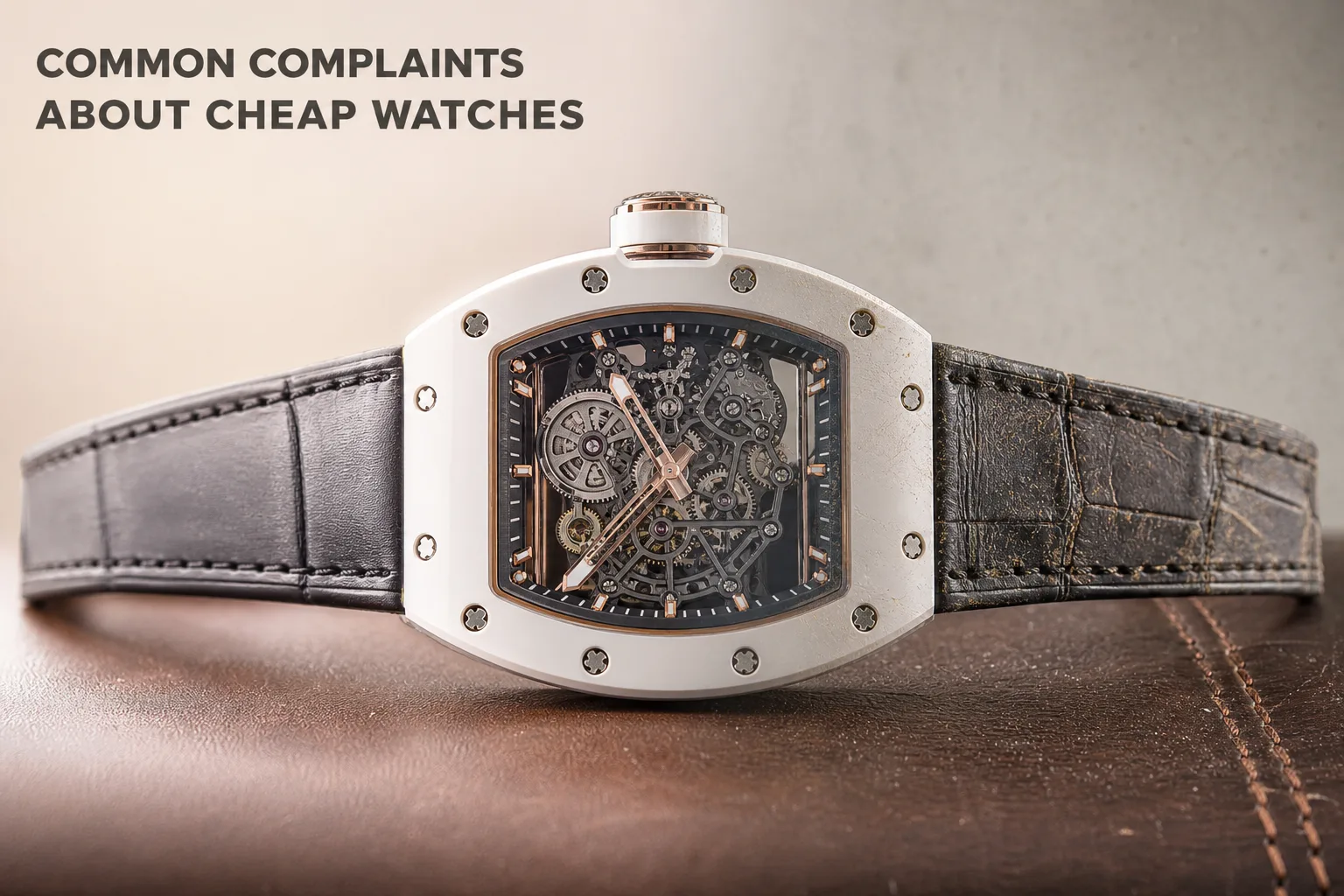
You find a watch that looks clean and sharp. The design is solid. The price feels almost too good. You buy it, and for the first week, things feel fine. Then the strap starts peeling. The glass picks up a scratch from nowhere. The movement stutters. And slowly, the watch that looked great on day one starts feeling like a burden.
Most people assume these problems are random. The truth is, they are entirely predictable. Cheap watches do not fail by accident. They fail because of specific decisions made during production. Once you understand those decisions, the complaints stop feeling like bad luck and start making complete sense.
WHAT "CHEAP" REALLY MEANS IN WATCHMAKING
The word 'cheap' in watchmaking does not just mean a low price. It means a series of calculated compromises. Manufacturers working at very low price points have to cut somewhere, and the cuts almost always happen in three areas: the materials used in the case and strap, the quality of the movement inside, and the level of finishing and assembly care applied at the end.
Understanding these three areas is the key to understanding every single complaint you will read below. None of it is mysterious. It is all traceable back to production choices made before the watch ever reached your wrist.
COMPLAINT #1: THE WATCH STOPS WORKING SUDDENLY
This is one of the most common complaints, and it catches buyers completely off guard. The watch was running fine, and then, without any obvious reason, it just stopped. No warning. No gradual slowdown. Just silence.
The reason is almost always the movement. Cheap watches use low-grade quartz movements with components that are not built to precise tolerances. The battery contacts are weak and oxidise quickly. The internal components shift or wear faster than they should because the materials used to make them are not durable enough for long-term use. The movement is not built to last. It is built to be cheap to produce.
If you are someone who wears a watch every day and expects it to simply work without interruption, this is the complaint that will frustrate you the most.
COMPLAINT #2: STRAP BREAKS, PEELS, OR FEELS CHEAP
The strap is the first thing to go on most budget watches. It starts with a slight stiffness that does not break in well. Then the edges start showing wear. Then the surface coating begins to crack and peel. Within a few months, you are left with a strap that looks worse than the watch it holds.
Budget straps are almost always made from synthetic leather with a thin coating on top to mimic the appearance of real leather. That coating is glued on rather than bonded into the material. Daily sweat friction and natural skin oils break it down faster than the watch itself. The strap was never meant to survive years of use. It was meant to look acceptable in a product photo.
This is worth understanding because the strap directly affects how a watch feels on your wrist every single day. A great dial means very little if the strap is uncomfortable or embarrassing to be seen in.
COMPLAINT #3: GLASS SCRATCHES TOO EASILY
Scratch resistance is something most buyers only think about after they have already scratched their watch. You set it down on a hard surface or brush it against a wall, and within days, there is a mark across the face that you cannot ignore.
Cheap watches use acrylic plastic or low-grade mineral glass for the crystal. Neither material has meaningful scratch resistance. There is no protective treatment applied, and the hardness of the material simply is not enough to hold up against daily life. Higher-quality watches use sapphire crystal or, at a minimum, properly treated mineral glass. Budget watches skip that step entirely because it adds cost.
A scratched crystal changes how a watch looks from every angle. It is a visible reminder of the quality compromise every time you check the time.
COMPLAINT #4: WATER RESISTANCE DOESN'T HOLD
The box says 'water resistant'. The watch gets splashed. Water gets in. The dial fogs over, or the movement starts misbehaving. This is a complaint that costs buyers real money because water damage is rarely covered by any warranty that comes with a budget watch.
The problem starts with the sealing. Proper water resistance requires quality gaskets fitted precisely around the crown, case back, and crystal. Budget watches use cheap gaskets that degrade quickly or are not installed with the precision needed to actually hold. Beyond that, the water resistance ratings on cheap watches are often untested marketing claims rather than verified specifications. The number on the dial means very little if the sealing was never properly tested.
COMPLAINT #5: THE WATCH LOOKS OLD TOO FAST
This one is subtle, but it is the complaint that makes people feel genuinely disappointed in a purchase. The watch looked clean and sharp when it arrived. Three months later the finish is dull. The colour on the dial has shifted slightly. The case has picked up marks that seem disproportionate to how carefully you treated it. The watch has aged poorly.
The root cause is the finishing process. Cheap watches use very thin plating layers on the case and bracelet. Thin plating wears through quickly, especially on edges and raised surfaces where contact is constant. The polishing is also done with less care, which means surfaces that looked shiny in photos appear uneven or cloudy in real light. There is no long-term wear resistance built into the finish because that would require better materials and more production time.
COMPLAINT #6: POOR METAL QUALITY: WEIGHT AND FEEL ISSUE
This is the complaint most buyers cannot immediately name, but they feel it the moment they put a cheap watch on. Something feels off. The watch is lighter than expected. It sits on the wrist in a way that feels hollow. The clasp or buckle feels flimsy. When you tap the case, it does not sound solid.
What they are experiencing is the result of low-density alloy being used instead of solid stainless steel. Many budget watches use zinc alloys or pot metal that is significantly lighter and less durable than proper steel. The case is often hollow or very thin-walled to reduce material costs further. The edges where the case meets the bracelet are rough because precise finishing takes time and money that budget production does not allow for.
Weight and finishing are not vanity details. They are the physical signals that tell your hand whether what you are wearing is a quality object or not. A watch that does not feel right on the wrist never really feels like yours.
WHY PEOPLE STILL CHOOSE CHEAP WATCHES
It would be easy to treat budget watch buyers as uninformed, but that would be unfair. Most people who buy cheap watches do so for completely understandable reasons.
Budget is the most obvious factor. Not everyone has room in their spending for a watch that costs several thousand rupees or more. Some people want the look of a dress watch or a sports watch for occasional use, and spending heavily on something worn twice a month feels difficult to justify. Others simply do not know the quality differences exist until they experience them firsthand. And some people genuinely believe that any watch will do the same job of telling time, regardless of what it costs.
None of these reasons is wrong. The problem is that the cost savings on a cheap watch often disappear quickly once replacements and repairs are factored in. What felt like a smart purchase starts feeling like a cycle of disappointment.
THE SMARTER ALTERNATIVE: BETTER THAN CHEAP, STILL AFFORDABLE
The good news is that budget and quality are not always opposites. There is a middle ground that a lot of buyers do not know exists.
Many people want the look of iconic luxury watch brands like Rolex, Omega and Tag Heuer but do not want to spend on an original. What they actually want is a watch that looks premium and holds up to daily wear without the price tag of an authenticated piece. That is a reasonable thing to want.
First copy watches at 7A quality are built to address the specific problems listed above. Better materials go into the case and strap. The finishing is applied with more care. The movements used are more reliable. The glass holds up better. The result is a watch that avoids the most frustrating complaints that come with purely cheap alternatives. If you are curious about how quality tiers work, it helps to understand the difference between 7A and AAA first copy watches before making a decision.
WHY CHOOSE US
We focus on offering affordable first copy luxury watches that balance style and durability. Our collection covers a wide range of designs suitable for every occasion and personal style. We pay close attention to build quality so that the issues described throughout this blog are not the experience you walk away with.
To make buying easier, we offer cash on delivery and a simple return policy. You can explore our full range of original vs first copy watches to understand exactly what you are getting before you order. We also have a detailed guide on what a first copy watch actually is if you are new to this category.
CHEAP VS BETTER ALTERNATIVES
Factor | Cheap Watches | Better First Copy Watches |
Materials | Low-grade alloys and synthetic coatings | Improved steel and real material straps |
Durability | Built for short-term use only | Designed for daily wear over time |
Appearance | Fades and peels within months | Maintains finish and colour longer |
Movement | Unreliable quartz with weak contacts | More stable movement with better components |
Value | Requires frequent replacement | Lower long-term cost per wear |
CHANGE HOW YOU JUDGE VALUE
A cheap watch is not always the cost-effective choice. When the strap fails after three months, and the movement needs replacing after six, and the finish is gone within a year, the original savings have already been spent. The real cost of a cheap watch is not just what you paid. It is what you will keep paying.
Understanding how to maintain your watch for the long term also makes a meaningful difference, regardless of which watch you choose. And if you are buying as a gift, there are excellent options worth exploring in our guide to first copy watch gift ideas for anniversaries.
The real value of a watch is not how little you paid for it. It is how long it continues to feel worth wearing.
If you want to explore options that avoid these common problems, you can find first copy watches online or read more about 7A first copy watches to understand what separates better quality replicas from purely cheap alternatives. For those who want to go deeper, our complete guide to watch movements explains exactly what is inside the watch you are considering and why it matters.
FREQUENTLY ASKED QUESTIONS
1. Why do cheap watches suddenly stop working?
Cheap watches use low-grade quartz movements where battery contacts oxidise quickly, and internal components wear out faster than they should. Understanding how watch movements work explains exactly why movement quality is the most critical factor in long-term reliability.
2. Why does the strap on my budget watch peel so fast?
Budget straps use synthetic leather with a glued surface coating that breaks down quickly under daily sweat and friction. Real material straps found on better first copy watches are bonded properly and hold up significantly longer.
3. What type of glass do cheap watches use, and why does it scratch so easily?
Most cheap watches use acrylic plastic or untreated mineral glass, which has almost no scratch resistance. Higher quality alternatives use sapphire crystal or treated mineral glass, as explained in our guide on what makes a good quality first copy watch.
4. Why does a cheap watch look worn out within just a few months?
Thin plating layers and poor polishing mean the finish wears through quickly on high-contact surfaces. Maintaining your watch correctly can slow this process but cannot fully compensate for low-grade finishing from the start.
5. Is buying a cheap watch ever a smart decision?
For daily use the cost of repeated replacements adds up fast, and a 7A quality first copy watch often proves more economical over time than cycling through cheap alternatives that fail within months.
6. What is a first copy watch, and how is it different from a cheap watch?
A first copy watch replicates the look and feel of a luxury design using better materials and more careful construction than a purely cheap watch. Our guide on what a first copy watch actually is covers everything you need to know before buying.