 1:1 Mirror Quality


Can you, as a normal person, genuinely imagine spending one lakh rupees or more on a watch? Just a watch. Something that sits on your wrist and tells you the time.
Some watches cost as much as a car. Others are priced higher than an apartment. A Rolex Submariner starts at several lakhs. An Omega Constellation will comfortably cross that, too. And then you have brands like Rado pushing boundaries with ceramic and sapphire. These are not just accessories. At these prices, they become a statement.
But what actually makes these watches so expensive? Are they genuinely worth the money? And is there a smarter way to enjoy that premium look without paying a premium price? Let us break it all down.
WHY ARE WATCHES SO EXPENSIVE
The price of a luxury watch is rarely the result of just one thing. Several factors stack on top of each other, and by the time the watch reaches your wrist, the cost reflects a combination of engineering, craft, materials, and reputation. Here is what is actually driving those numbers.
COMPLEX MECHANICAL MOVEMENTS
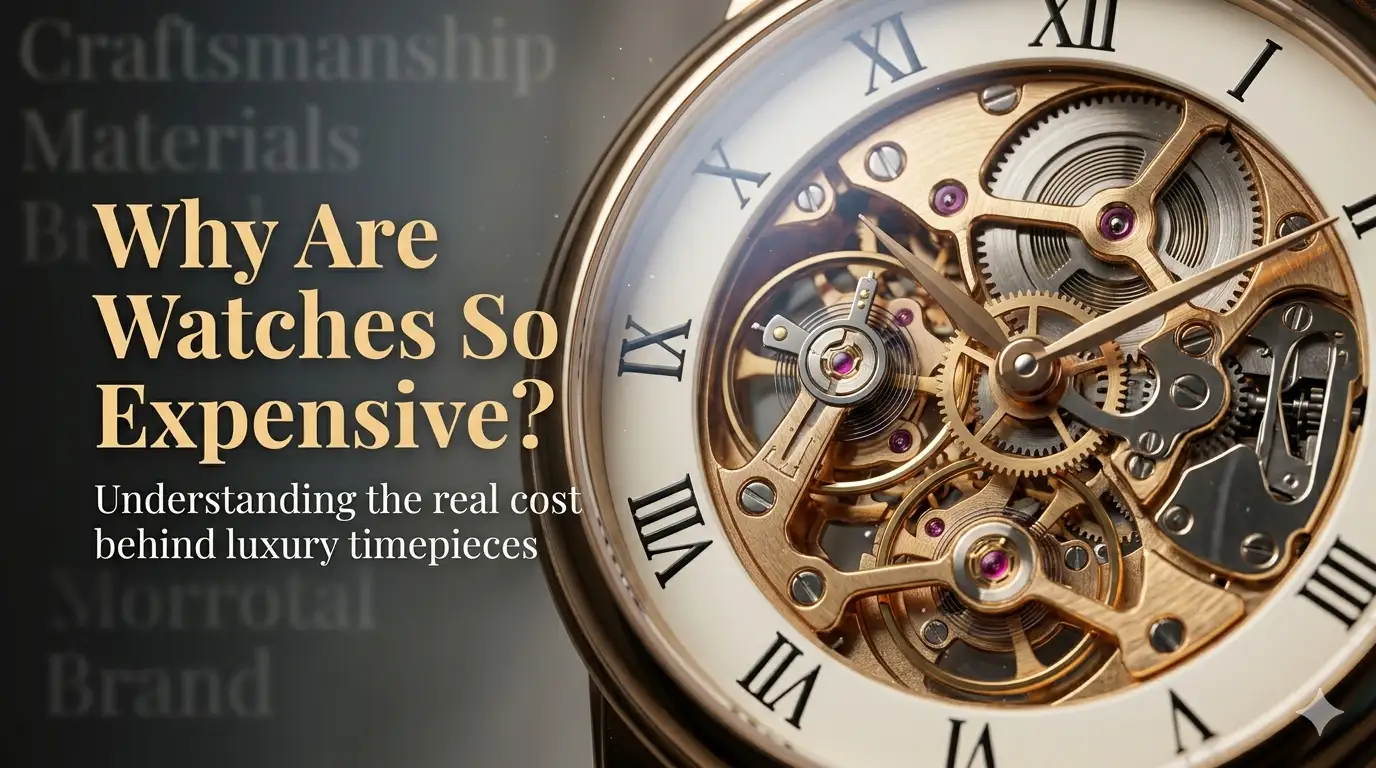
The movement is the heart of any watch, and in the luxury world, that heart is extraordinarily complex. A high-end mechanical movement can contain hundreds of individual components all working in precise coordination inside a case that fits on your wrist. Automatic movements wind themselves through the motion of your arm. Skeleton designs like those from Richard Mille expose the entire mechanism through the dial so you can watch the engineering work in real time.
Developing a movement at this level takes years of research and testing. Brands invest heavily in proprietary calibres, and that investment shows up in the retail price. If you want a deeper look at how movements actually work, this complete watch movement guide for buyers explains every key type clearly.
CRAFTSMANSHIP AND PRECISION
Luxury watchmaking at the top tier is almost entirely handmade. A single master watchmaker can spend hundreds of hours assembling and finishing one piece. Every component is bevelled and polished individually under magnification. Bridges are decorated with patterns like Cotes de Geneve or perlage that you can only see when the caseback is open. This is skilled labour of the highest kind, and the number of people capable of doing it properly is small. That scarcity of skilled crafts is reflected directly in price.
PREMIUM MATERIALS
The raw materials inside a luxury watch are rarely ordinary. Cases are machined from solid gold, platinum, or high-grade titanium. Crystals are grown from synthetic sapphire, making them nearly scratch-proof. Dials use materials like mother of pearl, meteorite, or hand-applied enamel. Even the gaskets used for water resistance are engineered to tight tolerances. None of this comes cheap at scale, and there is no budget version of sapphire crystal.
DESIGN AND DETAILING
Great watch design is not accidental. The proportions of a Cartier case, the dial layout of a Patek Philippe, and the integrated bracelet of an Audemars Piguet Royal Oak are the result of decades of refinement and, in some cases, genuine artistic vision. Every detail on a top-tier watch is intentional. The finishing alternates between brushed and polished surfaces in a way that takes enormous skill to execute consistently. That design legacy and the craftsmanship required to honour it add real value to every piece.
BRAND VALUE AND MARKETING
This is where the picture gets more complicated. Beyond the engineering and materials, a significant portion of the price is driven by brand equity. Rolex controls supply deliberately to keep demand higher than availability. The result is waiting lists that can stretch for years on popular models. Celebrities are seen wearing these brands at global events. That visibility and exclusivity create a perception of value that goes well beyond the object itself.
You are not just buying a watch. You are buying into a world that the brand has spent decades and enormous amounts of money constructing. That perception has real market value. But it is worth knowing that it is perception.
ARE THEY WORTH THE PRICE
The honest answer is 'sometimes yes and sometimes no'. It depends on what the watch actually delivers.
If a watch combines deep mechanical complexity with hand-finished components, proprietary movements, rare materials, and a genuinely innovative design, then yes, the price can be justified. You are paying for engineering that took generations to develop. You are paying for art. You are paying for something that will likely outlast you if maintained properly.
Many watches in the luxury tier are priced primarily on brand name recognition rather than on the actual complexity of the object. At that point, the justification gets thinner.
BUT HERE IS THE REALITY MOST PEOPLE IGNORE
A large part of what you pay for has nothing to do with the watch at all. It is the brand attached to it. The name on the dial. The perception it creates in a room. The exclusivity has been carefully manufactured over decades of controlled supply and deliberate marketing.
When you buy a watch with a famous name on the dial, you are partly buying the right to advertise that brand on your wrist. You are paying for the story that the brand wants the world to associate with their name. Status. Success. Taste. These are not qualities of the object. They are qualities of the narrative.
That does not make luxury watches wrong or dishonest. But walking in with clear eyes about what you are actually paying for changes how you think about the decision.
WHY IT MAY NOT BE PRACTICAL FOR EVERYONE
Even if you could justify the paper price, daily life has a way of complicating things. Wearing a watch worth several lakhs to the office means thinking about it constantly. You hesitate before a casual outing. You worry at the gym. You think twice before putting it down anywhere. The anxiety is real, and it follows you everywhere the watch goes.
There is also the straightforward reality that most people simply cannot spend lakhs on a watch. And even those who can might reasonably question whether that money serves them better elsewhere. A watch that costs you stress every time you wear it is not really doing its job.
For most people, spending that much on a watch does not make practical sense. Not when the same look is available for a fraction of the price.
THE SMART ALTERNATIVE
So what if you genuinely love the look of a luxury watch but have no interest in spending lakhs to own one? What if you want that clean Rolex dial or that bold Omega case without the financial weight that comes with the original?
That is exactly where a smarter alternative comes in. And it is one that more people are choosing every year.
INTRODUCING FIRST COPY WATCHES
A first copy watch is a luxury-inspired timepiece built to replicate the visual design of a high-end original. The proportions are faithful. The dial details are carefully matched. The case shape and bracelet finish closely follow the reference. The result is a watch that carries the same aesthetic presence as the original at a price that is genuinely accessible.
The most popular first copy references are inspired by brands like Rolex, Omega, and Richard Mille. These are the designs that define what a luxury watch looks like in the public imagination, and first-copy versions bring that look within reach.
If you are trying to understand the difference between grades and what each tier offers, this comparison of original vs first copy watches gives you a clear picture before you decide.
WHY THIS OPTION MAKES SENSE
Explore why first copy luxury watches offer premium style, everyday practicality, and iconic looks at an affordable price.
AFFORDABLE
Original luxury watches run from several lakhs to several crores. A quality first copy typically sits between Rs 3000 and Rs 10000 depending on the model and grade. That is a fraction of the original, and it means you can own the look of something exceptional without financial pressure.
PREMIUM LOOK
A well-made first copy captures the visual identity of the original almost completely. The case proportions are right. The dial layout is faithful. The bracelet finish matches closely. Among the most popular luxury watch brands in 2026 the first-copy versions are refined enough that most people in a room cannot tell the difference at a glance.
PRACTICAL FOR DAILY USE
You wear it, and you enjoy it. No hesitation. No stress about scratches or damage. You take it everywhere without a second thought. That ease of wearing is genuinely valuable. You can read more on how to maintain your watch for the long term to keep any watch in good shape, regardless of what you paid for it.
VARIETY FOR EVERY OCCASION
Because the price is reasonable, you can actually build a small collection. A clean dress watch for formal events. A sporty diver-style piece for weekends. A minimalist design for the office. That kind of variety is only possible at this price point, and it lets your watch say something different about your personality depending on the occasion.
First copy watches also make excellent gifts. Whether you are shopping for a birthday gift or looking for the perfect anniversary present, the options are wide, and the price point makes it genuinely comfortable to give something that looks impressive.
WHY QUALITY AND THE RIGHT SELLER MATTER
Choosing smart means choosing the right place to buy. Not all first-copy watches are made the same way. The market ranges from poorly made pieces that wear out quickly to well-constructed watches that hold up beautifully for years. The seller you choose determines which experience you get.
Here is what a trusted seller should offer. Clear and accurate product descriptions so you know what you are getting before it arrives. High-resolution images that show the real finish of the case and dial. Cash on delivery, so you can inspect the watch before making payment. A clear return and replacement policy that protects you if the piece does not meet expectations. And genuine experience in the first copy space, so their recommendations actually mean something.
Before you buy anything, read this guide on 6 ways to spot a good-quality first-copy watch so you know exactly what to look for in both the product and the seller.
Understanding the difference between 7a and AAA-grade first-copy watches also helps because the quality gap between tiers is real and worth knowing before you spend.
If you are not sure where to start, this guide on where to find first copy watches in India walks you through trusted sources and what to expect from each.
CONCLUSION
Luxury watches can be extraordinary objects. The engineering behind a proper mechanical movement is genuinely impressive. The craftsmanship of a hand-finished dial is real art. For collectors who understand and appreciate that world, the price can make sense.
But for most people who want to look polished every day, the maths simply does not work in favour of spending lakhs on a name. You would be paying heavily for branding you do not need and worrying about a watch you cannot afford to damage.
First copy watches give you what you actually use every day. The look. The style. The confidence. The variety. At a price that leaves your wallet intact and your mind at ease.
Browse the full collection of first-copy watches online and find the one that fits your style today.
FREQUENTLY ASKED QUESTIONS
1. ARE FIRST COPY WATCHES LEGAL IN INDIA?
Bing for personal use is widely practised, and most buyers face no issues. Avoid reselling them as originals, and you will have no problems.
2. HOW LONG DO FIRST COPY WATCHES LAST?
A good quality piece lasts two to three years with basic care. Avoid water exposure and clean the bracelet regularly.
3. WHAT IS THE DIFFERENCE BETWEEN 7A AND AAA GRADE?
An AAA grade has better finishing and a more reliable movement. 7A is entry-level. Always go for AAA if daily wear is your goal.
4. CAN I WEAR A FIRST COPY WATCH TO THE GYM OR OUTDOORS?
Yes. That is actually the biggest advantage. You wear it freely without worrying about damage.
5. WHICH BRAND LOOKS BEST IN THE FIRST COPY?
Rolex and Omega replicate the best because their designs are clean and well-defined. Richard Mille copies also turn heads due to the bold skeleton look.
6. DO FIRST COPY WATCHES KEEP ACCURATE TIME?
A quality first-copy watch with a decent movement keeps reliable time for daily use. Do not expect chronometer precision, but it will serve you well.